
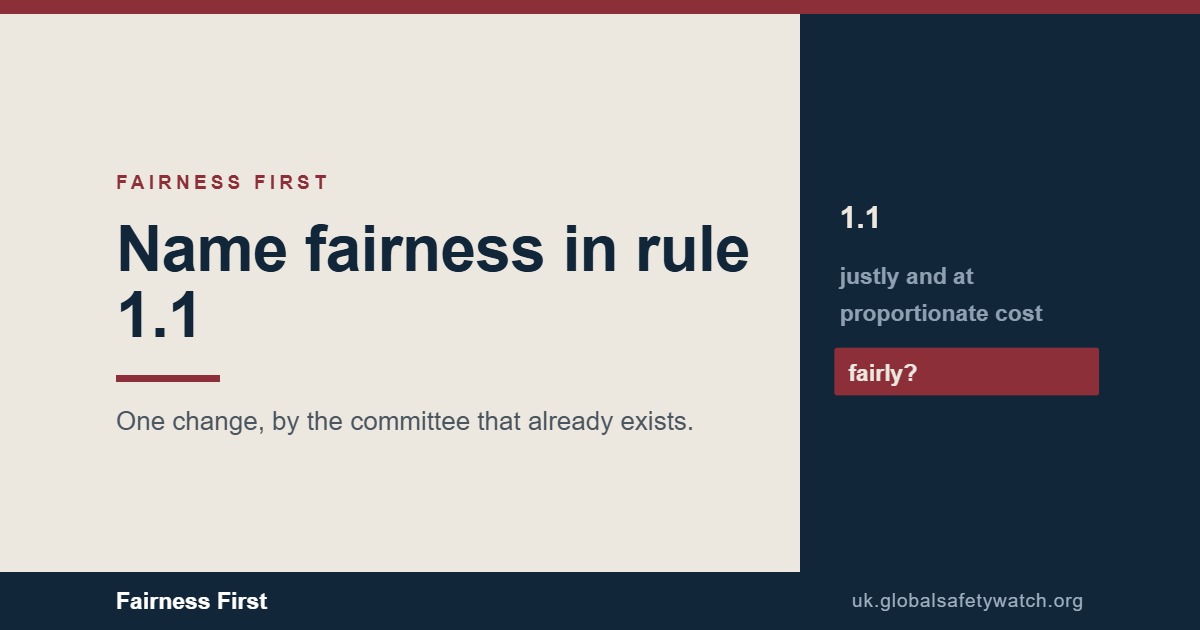
One rule runs every civil case, from banking to social care. This campaign adds one word: fairly
Whether it started with a bank, with care for a relative, with a landlord or with a debt, the case is run under one rule. That rule tells the court to deal with cases justly and at proportionate cost
. Cost is in that sentence. Fairly is not.
Naming fairness in that sentence puts it where cost already is, in the rule that overrides all the others. That is worth the same to everyone who ever has to use a court.
It needs no new law and no Act of Parliament. The committee that writes the rule can do it, and it costs nothing.
The rule, in its own words
The first rule tells a court to deal with cases justly and at proportionate cost
. Cost was written into that sentence in 2013. The word fairly
appears once in the whole rule, in the list beneath that sentence, at rule 1.1(2)(d): ensuring that it is dealt with expeditiously and fairly
. That list applies only so far as is practicable
.
Fairness is in the rule only so far as it is practicable. This campaign calls it the optional fairness rule.
In 1997 Parliament said these rules must be made with a view to a civil justice system that is accessible, fair and efficient
. Moving fairness into the sentence where cost already sits is the whole of the ask.
Why this has to change
Parliament said fair. The rule says cost. Nobody has to behave badly for a case to go wrong after that, because the sentence that overrides every other rule in a civil court does not name the thing people go to court for.
The pattern
Three doors, five years, one apology. A family complained about a council’s children’s social care and every free route closed, in the institutions’ own words, before the council said sorry anyway. Below it, the banking case that started this campaign: the same three gates, five and a half years, on a court record anyone can check. Two sectors, two ombudsmen, one shape.
Banking. Seven things the record shows
Each one is a document, a date and a rule. Open any of them.
Offered a remedy for lies. Never given itA month before the trial the court said contempt was the answer if a witness lied on paper. When he applied for it, the same rule that pointed him there was the reason to put it off. His application, filed in June 2022, has never been heard.
Four ways to close your complaint. None to stop a court caseWhen something goes wrong with a bank or a lender there are two roads. On the complaint road the firm has to prove it treated you fairly, and it costs you nothing. On the court road you have to prove everything. The firm can close the complaint road four ways. Nobody can close the court road.
A complaint closed in three working daysHe complained on the Friday. The firm wrote that day to say the complaint was under review and that someone would be in touch the next week. By the Wednesday it had withdrawn the complaint, because it felt he had already been answered. One answer it named was a letter from its litigation solicitors, sent on the day he complained, saying no settlement offer had been received. Those solicitors apologised the day after: the firm had the offer after all.
Booked in as a one day case. It never wasAt the start a court puts every case in one of three boxes. The box decides how much time and evidence it gets. His went in the smallest, for cases expected to take a day. The trial grew to two days. The rules allow a move at any time. It was never moved.
Refused expert evidence then told he has no proofHe asked to use a forensic accountant to prove what the dispute had cost him. The decision was put off to the end of the trial, then refused. His claim was dismissed for want of the very proof the accountant was to give.
The UK has already promised it
Parliament put fairness first. The rule does not.
“The power to make Civil Procedure Rules is to be exercised with a view to securing that the civil justice system is accessible, fair and efficient.”
Civil Procedure Act 1997, section 1(3). The duty Parliament gave the rule committee.
“These Rules are a procedural code with the overriding objective of enabling the court to deal with cases justly and at proportionate cost.”
Civil Procedure Rules, rule 1.1(1). The sentence that overrides every other rule. Cost is in it. Fairness is not.
“My Government’s legislative programme will be mission led and based upon the principles of security, fairness and opportunity for all.”
The King’s Speech, setting out the Government’s programme, 17 July 2024.
“The Rule of Law: the certainty of stable and accessible rules, an independent judiciary resolving disputes and delivering impartial justice.”
The King, addressing the United States Congress, 28 April 2026. Matters of public record. No endorsement of this campaign is stated or implied.
Fairness is the word Parliament used in 1997 and the word the Government put at the centre of its programme. It is not in the sentence that overrides every other rule in a civil court.
Who is behind this
Stuart Thompson pioneered one of the world’s first artificial intelligence markets, now forecast to pass $100 billion by 2035. He has fought for his property since 2020. This campaign is not asking for his case to be reopened. It asks for one rule to be reworded.
This is not about my case. It is about the rule that decided how my case was run, and the accident that let me prove it.
My case is nothing in comparison to many that I’ve followed. The only exception is the accident that led to this campaign.
People are using this campaign
Who checks it. Reach and monthly audience are measured by independent site and audience measurement, not by our own counts, and audited before any figure is published. Supporters are counted from our own database of registered campaign followers.
Spearhead Action Plan
Five pages: the rule, why it fails, one case, and the ask. Print it, check it, send it to anyone who should read it.
PDF, 0.5MB, opens in a new tab.
See the evidence behind this, with its sources.
This campaign is not connected to any political party and does not support or oppose any party or candidate. It is not connected with the Civil Procedure Rule Committee. The case referred to is Santander UK PLC v Stuart Thompson, claim G1PP9250; no judge is named, because the argument is about a rule and not a courtroom, and the proceedings are continuing, so nothing here is intended to influence their outcome. Court words are quoted in short extract and are Crown copyright. Nothing on this site is legal advice. If you are struggling, the Samaritans answer free on 116 123, day and night.