
Five and a half years, and what it proves
Five and a half years. Twelve hearings listed, ten held. A possession claim against Stuart Thompson over mortgage arrears, met by a counterclaim the Court was told was worth many times more. Everything below is taken from documents filed in these proceedings, from orders made in them, from the Court’s own correspondence, and from an approved judgment transcript.
“it is in accordance with the overriding objective that the Trial should take place”
The High Court, deferring the contempt application until after the trial

Each dark mark is a hearing that took place. The hollow mark is the first hearing, adjourned by the pandemic. The two red marks are trial dates lost: the first stood out before a date was set, the second taken out of the list four days before it was due. The grey stretch of 553 days includes the pandemic stay. The red stretch of 391 days had no pandemic to explain it.
Act one. March to April 2020. Thirty four days
The claim. Issued over arrears of £21,553.58. The checklist certifying that the pre-action rules had been followed is dated the same day, is unsigned, and names a firm under a name it would not adopt for another fourteen months. The judgment records that no explanation was given.
What their own file already said. On 29 January 2020, six weeks before this claim was issued, Santander’s own file recorded that the mortgage appeared “to have been sold on an advice basis”. On an advised sale it is the firm, and not the customer, that has to show the sale was suitable. That is where the burden sat, on their own record.
Referred up, then closed. Two days later, on a call Santander recorded, its complaint handler said the mis-selling point was with policy because of the legal points in his letters: “She’s referred this to policy at the moment which is where it stands … I understand there’s a few legal points in the letters that you’ve sent in. So at the moment we’re with policy with that.” Her own file note, written one minute later, records the same. Four business days later the complaint was closed, and he was told that if he wanted to pursue the mis-selling it would have to be done through the court.
The offer denied, admitted, rejected. His settlement offer, worth two and a half times the claimed arrears, went unanswered for 72 days. On 3 April Santander’s solicitors wrote that no offer had been received. Two business days later its own file recommended no further response. On 9 April, the last working day before the hearing, the solicitors apologised: it had the offer. The same letter rejected it, and gave no reason.
What the pandemic did. The hearing of 14 April 2020 did not go ahead. On that date no reason for refusing the offer existed on paper. The stay gave him what the rule gives nobody: time. Everything now on the record was found in it.
My case is nothing in comparison to many that I’ve followed. The only exception is the accident that led to this campaign.
Stuart Thompson.
Act two. April 2020 to October 2021. Eighteen months without a hearing
553 days to the first effective hearing.
The reason, a year and a half late. The first reason for rejecting the offer arrived on 13 August 2021, one year, six months and sixteen days after the offer was made. It later changed.
The affidavit. In October 2021 the Court read his affidavit, took from it that any money owed was “dwarfed by the losses I have suffered”, and told him he had a recognised counterclaim. In the same hearing it refused the affidavit as evidence and barred any more. Good enough to create the counterclaim; refused as evidence in it.
The fast track. The case was put on the track for claims expected to be tried in a day. His counterclaim was then recorded at over £200,000. The trial later grew from one day to two. The rules let a court move a case to a larger track at any time. This one was never moved.
Act three. 2022 to 2023. The trial that kept moving
Admitted, at last. On 10 May 2022 Santander accepted in a witness statement that his offer “was received by the Claimant prior to the issue of the current proceedings”, two years and twenty six days after the hearing the pandemic adjourned.
Six months of silence. On 12 January 2023 Stuart asked for the case to be moved to the High Court. The request needed a judge’s decision; the Court later apologised that his letter “was overlooked in favour of your more recent correspondence in error”. The apology took 174 days.
Stood out before a date was set. On 15 May 2023 a hearing was stood out “due to a lack of judicial time”. The Court’s own complaint reply of 5 July 2023 shows no date had yet been set.
Too close to move, then taken out anyway. On 30 October 2023 the Court refused a transfer because “the two day trial scheduled to begin in two weeks’ time will not happen”. Ten days later that trial was taken out of the list, four days before it was due.
Act four. 2023 to 2026. The rule, the judgment, and what is still open
The rule, caught deciding. A month before the trial the High Court told Stuart he did not need sworn affidavits because contempt was a sufficient remedy for lies in a witness statement: a witness who gave false evidence would “attract a sufficient penalty” and commit an act “tending and intended to pervert the course of justice”.
When Stuart brought that very contempt application, the High Court deferred it until after the trial, because “it is in accordance with the overriding objective that the Trial should take place” first.
The remedy was the reason to refuse him protection, and the overriding objective was the reason to withhold the remedy.
His application, issued in June 2022, has never been heard.
The expert refused. His application for a forensic accountant was listed to be decided at the start of the trial it was meant to prepare him for, then deferred to its end. He ran the trial not knowing whether the expert would be allowed. The answer was no.
Possession. Ordered in November 2025, with a money judgment of £298,740.36, of which £153,740.36 is described as arrears and has never been itemised. The counterclaim was dismissed for want of proof of loss, the loss he had asked the refused expert to quantify.
Where it stands. An appeal and a judicial review are live.
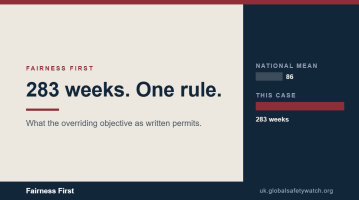
At judgment it was said that the time this case took beyond the usual was the result of Stuart’s own applications, and that he was entitled to make every one of them. The usual, on the Ministry of Justice’s own figures, is 68.6 weeks from claim to trial, on the quarterly figures published in June 2026. This case took 283, four years and one month longer. Eleven of those months contain no application of his at all: the five months the Court took to calculate its own fee, and the six months his letter went unanswered.
The documents
The Financial Ombudsman’s decision of 9 July 2019, the firm’s letters and emails of 3, 6, 7 and 8 April 2020 and its solicitors’ letters of 3 and 9 April 2020, with the names of staff and the customer’s details removed, and every date, reference and role kept. Fourteen pages. Nothing filed in the proceedings is included.
Download the banking pack PDF, 1.6 MB, opens in a new tab.
Extracts from three of the firm’s own call recordings, 31 January, 3 February and 6 February 2020, in the handler’s own words. No individual is named and the customer’s personal details are removed. Four pages.
Download the recorded evidence PDF, 46 KB, opens in a new tab.
What the firm wrote in its own records, obtained by asking for the information it held, is set out on what their own records show.
Nothing in this account required anybody to behave badly. Why this has to change sets out how one sentence produces it, and why one word closes the gap.
People are using this campaign
Who checks it. Reach and monthly audience are measured by independent site and audience measurement, not by our own counts, and audited before any figure is published. Supporters are counted from our own database of registered campaign followers.
Make fairness first Been through the courts? Draft your letters. Two minutes
Note on sources. The case is Santander UK PLC v Stuart Thompson, claim G1PP9250. Drawn from Mr Thompson’s own statements of case, applications, affidavit, grounds, chronology and skeleton arguments, including the claimant’s own letters and records quoted in them, from orders made in the proceedings, from the Court’s own correspondence, and from transcripts of judgment approved by the judge, which are Crown copyright and quoted in short extract only. No judge is named. The proceedings are continuing and nothing here is intended to influence them. Nothing on this page is legal advice.